Why I Started Building Scaffold
Most side projects solve a single problem.
Scaffold slowly became something else.
It started from repeated friction during development — navigating large codebases, context switching between tools, debugging UI issues, handling repetitive workflows, and rebuilding the same engineering foundations again and again.
Instead of treating those as isolated annoyances, I started treating them as signals.
Signals that modern development workflows still waste a lot of mental bandwidth.
Scaffold became my attempt to rethink that foundation.
---
content-video
The Core Idea
The goal behind Scaffold is simple:
Reduce engineering friction so developers can focus more on building and thinking.
That sounds small, but it affects everything:
- project structure
- tooling
- developer workflows
- browser utilities
- UI debugging
- automation
- architecture decisions
- extensibility
- long-term maintainability
Rather than creating disconnected tools, Scaffold focuses on building systems that work together.
---


profile-pic
Engineering Principles Behind Scaffold
Build for Scale Early
Even small tools are designed with extensibility in mind.
Instead of hardcoding behavior for one use case, I try to design abstractions that can support future features without large rewrites.
This includes:
- modular architecture
- reusable utilities
- isolated feature boundaries
- predictable state handling
- scalable folder structures
Optimize Developer Experience
A surprising amount of productivity loss comes from tiny interruptions.
Scaffold focuses heavily on reducing those interruptions.
Examples include:
- reducing navigation overhead
- minimizing repetitive actions
- improving debugging visibility
- making workflows more discoverable
- exposing useful context faster
The goal is not just speed.
It is preserving cognitive flow.
Treat Tools Like Products
Even internal tooling deserves good UX.
I care about:
- intuitive interactions
- polished interfaces
- low-friction onboarding
- visual clarity
- meaningful defaults
A developer tool should feel engineered, not just assembled.
---
What Scaffold Includes
Scaffold is not a single application.
It is a growing ecosystem of experiments, utilities, and engineering systems.
Some areas include:
Browser Extensions
Extensions focused on improving developer workflows directly inside the browser.
Examples include:
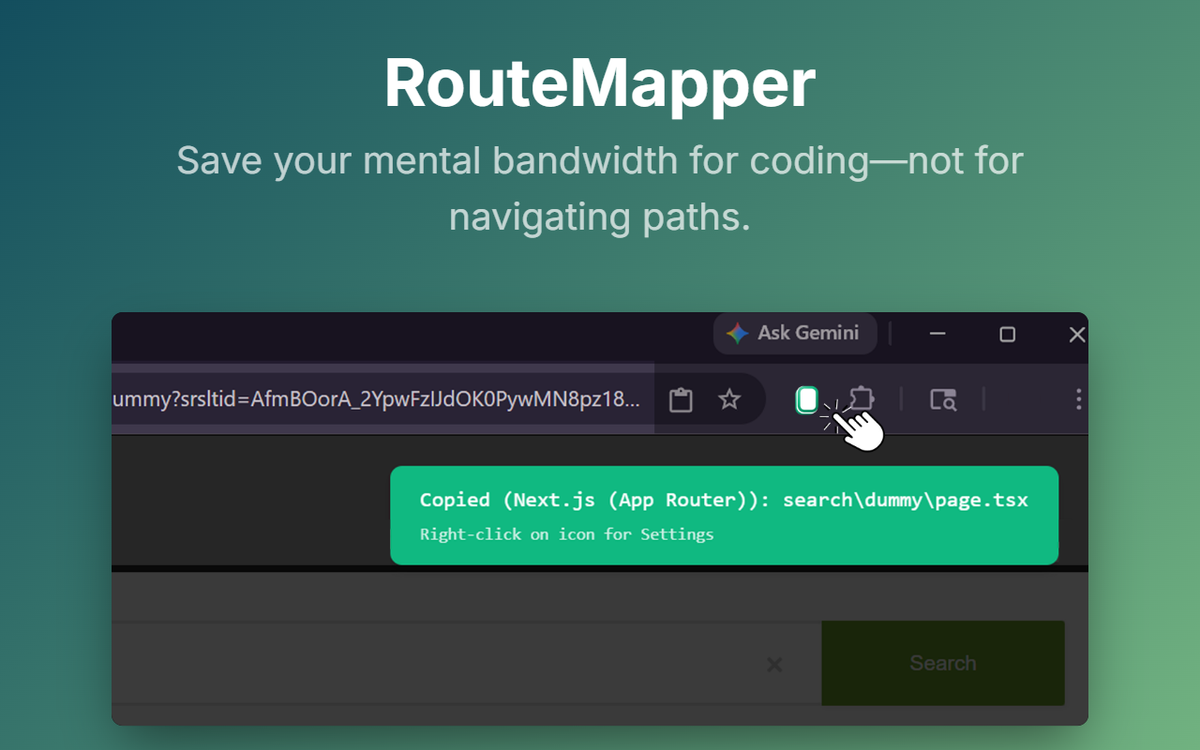
- route mapping utilities
- UI inspection workflows
- interaction debugging
- image and asset tooling
- developer-focused overlays
Workflow Automation
Automating repetitive engineering tasks that usually consume unnecessary time.
This includes:
- structured generation flows
- transformation pipelines
- developer shortcuts
- tooling integrations
- workflow optimizations
UI + Debugging Systems
A large focus of Scaffold is improving visibility during frontend development.
The idea is to make debugging and inspection feel less reactive and more intentional.
Architecture Experiments
Scaffold also acts as a sandbox for testing:
- scalable frontend architecture
- component organization
- state patterns
- extension communication systems
- future-ready tooling approaches
---
What I Learned While Building It
Small Frictions Compound
A few seconds lost repeatedly becomes real engineering cost.
Good tooling is often invisible because it removes friction before you notice it.
Engineering Is Also About Systems Thinking
Building Scaffold forced me to think beyond writing features.
I had to think about:
- maintainability
- workflows
- extensibility
- tradeoffs
- user behavior
- architecture longevity
Simplicity Is Difficult
Making something flexible while keeping it simple is significantly harder than adding more complexity.
A large part of the project became learning where abstraction actually helps — and where it hurts.
---
The Long-Term Vision
Scaffold is still evolving.
The long-term direction is to create a foundation of developer tooling and systems that:
- reduce workflow friction
- improve engineering clarity
- encourage scalable thinking
- integrate naturally into development workflows
- remain adaptable as technologies change
I want Scaffold to feel less like a collection of tools and more like an engineering layer that quietly improves how developers work.
---
Final Thoughts
Scaffold has been one of the most important projects I have worked on — not because of its size, but because of the way it changed how I think about engineering.
It pushed me to think about systems instead of isolated features.
To think about workflows instead of only interfaces.
And to design software not just for the present problem, but for the future evolution of the product itself.
That mindset is ultimately what Scaffold represents.